Introduction
The “Horse Stand” is a visually impressive equestrian performance in which a trained performer appears standing upright on a moving horse. It is commonly associated with professional trick riding, circus horsemanship, and equestrian vaulting-style performances.
Although the finished movement can look effortless, it depends on much more than simply “standing on a horse.” The horse’s training, predictable movement, specialized equipment where appropriate, the performer’s balance and conditioning, professional coaching, and carefully planned choreography all contribute to the performance.
For AI filmmakers and video creators, understanding these principles is particularly useful because realistic generated footage should show the small movements and transitions that make such a performance believable.
This article explains what is happening visually and physically during a professional Horse Stand performance.
The Horse Is an Active Part of the Performance
The first thing to understand is that the horse is not simply a platform underneath the performer.
A horse continuously produces movement through its gait. Its back, shoulders, and entire body move rhythmically as it travels. The performer therefore has to respond continuously to that motion.
In a professional performance, the horse is trained for the specific environment and choreography. Its movement should appear calm, predictable, and controlled rather than frightened or erratic.
For a realistic AI-generated scene, this means the horse should not look frozen while its legs move underneath it. Its head, neck, mane, body, and tack should show subtle movement associated with forward travel.
What the Performer Is Doing
When viewers see a performer standing upright, it may look as though she has simply reached a position and remained motionless.
In reality, maintaining the appearance of a stable pose involves continuous small corrections.
The performer’s knees, hips, torso, shoulders, and arms can all contribute to maintaining overall alignment as the horse moves. These corrections may be so subtle that an audience barely notices them.
This is one reason an AI-generated performer who remains perfectly rigid can look artificial.
A believable Horse Stand should contain tiny, controlled body movements.
The Preparation Phase
A convincing performance has a preparation phase before the main standing position.
Visually, the performer first appears secure and composed while the trained horse follows its choreographed path. The performer then prepares for the transition by stabilizing the body and coordinating movement with the horse.
The important visual principle is that the standing position should not appear instantaneously.
For AI video generation, avoid showing the performer suddenly “teleporting” from a lower position to a completely upright stance.
Instead, show a continuous transition in which the body gradually changes position while remaining synchronized with the horse.
Transitioning Toward the Upright Position
The transition is one of the most important parts of making a Horse Stand look believable.
The performer’s body rises progressively rather than snapping into position. The torso becomes more upright as the movement develops, and the arms can begin contributing visibly to balance.
The horse should continue its controlled movement throughout the sequence.
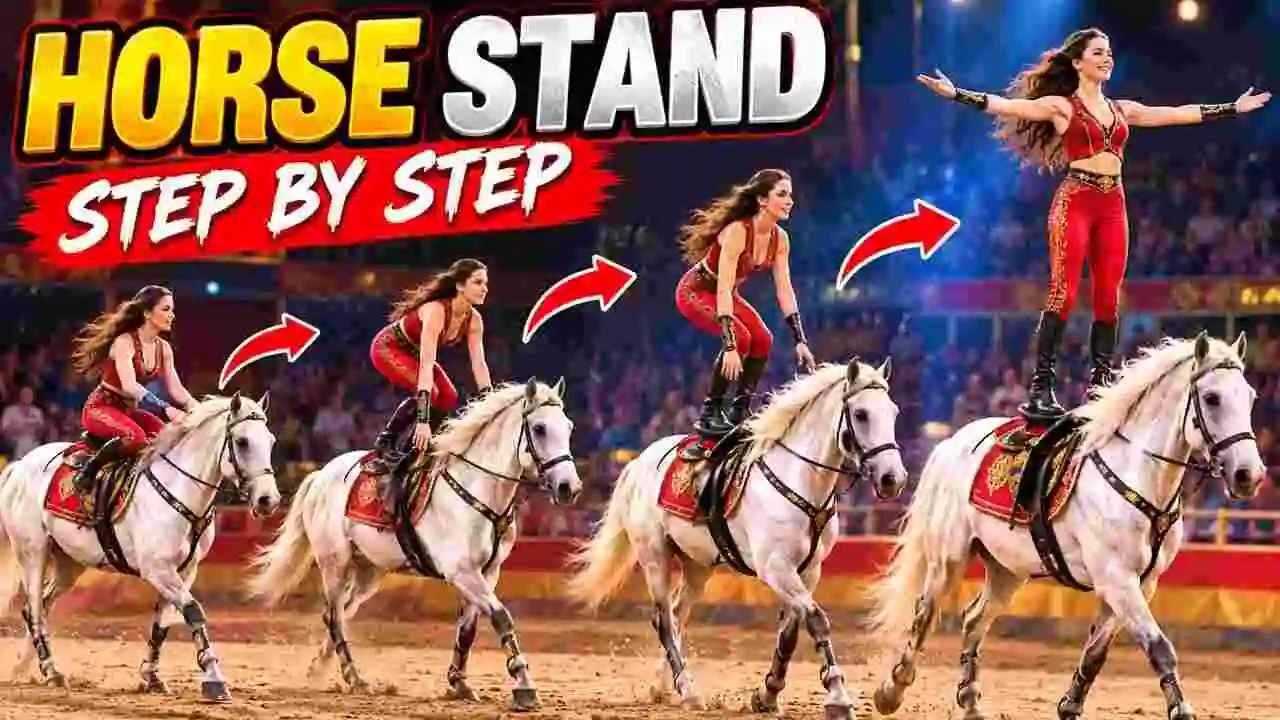
From a filmmaking perspective, the viewer should be able to understand the progression:
Preparation → Controlled transition → Rising body position → Upright position → Stabilization
Showing these intermediate states makes the movement much more convincing than cutting directly between two dramatically different poses.
The Main Standing Position
Once upright, the performer should look strong but not unnaturally rigid.
The torso generally appears tall and controlled. The legs remain responsive to the horse’s movement, while the arms may be extended or positioned according to the choreography.
The performer’s head and eyes usually appear purposeful rather than randomly moving around.
Most importantly, the entire body should appear connected to the movement occurring underneath it.
If the horse changes its rhythm slightly, the performer should display a corresponding subtle adjustment.
Why the Knees Should Not Look Completely Locked
One common mistake in AI-generated Horse Stand footage is showing perfectly straight, completely rigid legs while the horse is visibly moving.
That can make the performer resemble a static 3D model attached to the horse.
A believable performance should visually communicate flexibility and responsiveness. Subtle changes in the legs and body can help absorb and accommodate movement.
For AI video generation, phrases such as:
“subtle natural balance corrections”
“responsive body movement”
“controlled knee and hip adjustments”
and
“physically believable synchronization with the horse’s gait”
can help communicate the desired visual result.
The Role of the Arms
The arms are one of the clearest visual indicators of balance.
During a professional performance, arm position can also be part of the artistic choreography.
At one moment, the performer may use a wider arm position. Later, the arms can move into a more elegant presentation pose once the performer appears completely established.
For AI footage, arm movement should generally be smooth and purposeful.
Avoid frantic arm movements unless the story specifically requires the performer to appear momentarily unstable.
A skilled performer should look controlled.
The Torso and Core
The torso is visually important because viewers instinctively use it to judge whether the performer appears balanced.
Excessive uncontrolled bending makes the performance look unstable. Perfectly rigid posture, however, can also look artificial.
The most convincing appearance lies between these extremes.
The performer should look upright and controlled while still making subtle natural adjustments to the horse’s movement.
This distinction is especially important in close or medium camera shots.
Synchronization With the Horse
The performer and horse should look like two parts of the same choreographed movement.
When the horse moves forward, the performer should not appear independently animated.
The body should respond naturally to changes in the horse’s gait.
Hair can move slightly.
Clothing can respond subtly to motion.
The performer can make tiny balance corrections.
The horse’s mane and tail can move naturally.
The tack should remain correctly positioned rather than sliding or changing shape.
Together, these details create the impression of physical interaction.
Moving From Basic Standing to Performance Poses
After establishing a stable standing position, professional choreography can progress into visually more interesting poses.
For example, an AI-generated performance might show the performer first maintaining a straightforward upright pose and then transitioning into different arm positions or other professionally choreographed balance poses.
The important principle is progression.
Do not have the performer instantly switch from one extreme pose to another.
Instead, show the transition itself.
For video generation, a believable sequence might visually progress as:
Stable stand → preparation → gradual weight adjustment → new pose → stabilization → presentation
This gives the AI model intermediate movement to generate and gives the viewer a clear sense of physical continuity.
Why Horse Speed Matters Visually
The apparent speed of the horse strongly affects how the performance looks.
A slow, controlled sequence communicates stability and gives viewers time to understand the performer’s position.
Faster movement creates more visible motion throughout the horse, performer, hair, clothing, and camera.
For realistic AI footage, all of these elements need to agree.
A rapidly moving horse combined with completely motionless hair and a perfectly rigid performer looks artificial.
Likewise, extreme body movement on a horse that is barely moving can look exaggerated.
The amount of visible motion should correspond to the horse’s apparent gait.
The Finishing Pose
A professional performance often benefits from a clear visual finish.
Once the primary movement is complete, the performer can return to a stable presentation position.
The arms may rise or open into a confident finishing pose while the horse continues its controlled path or gradually slows according to the choreography.
The audience can then respond with stronger applause or cheering.
This provides visual closure.
For AI-generated videos, it is particularly useful because a stable finishing pose also creates a clean point at which to end a clip or transition into another generated segment.
What Makes an AI Horse Stand Look Fake?
Several mistakes immediately reduce realism.
The performer should not suddenly jump between positions without intermediate movement. Her feet should not slide or float relative to the performance equipment. The horse should not change size, color, anatomy, or direction unexpectedly.
The performer’s body should also avoid impossible twisting or duplicated limbs.
Another major problem is excessive rigidity. If the horse is clearly moving but the performer looks completely frozen, the physical relationship between them disappears.
Finally, camera movement must match the intended recording style. If the scene is supposed to be recorded by a spectator, an impossible drone-like orbit around the moving horse can undermine the realism.
How to Represent the Movement in an AI Video Prompt
Instead of writing:
“Woman stands on a moving horse.”
describe the visible progression.
For example:
“The trained horse moves forward at a steady, controlled pace while the professional adult performer completes a smooth choreographed transition into an upright standing position. Her torso gradually becomes vertical, and her arms extend naturally for balance. Once upright, she maintains the pose with subtle responsive movements through her legs, hips, torso, and arms that correspond naturally to the horse’s gait. She remains controlled rather than rigid while the horse continues moving steadily through the arena.”
This description gives the video generator information about both the pose and the motion connecting the poses.
A Realistic 10-Second Visual Sequence
For an AI-generated scene, ten seconds can be structured visually like this:
0–2 seconds:
The trained horse is already moving through the arena at a steady controlled pace. The professional performer is secure and preparing for the choreographed transition.
2–4 seconds:
The performer begins transitioning upward in one continuous controlled movement. The camera follows from the audience.
4–6 seconds:
Her body progressively reaches the upright position while the horse maintains its rhythm.
6–8 seconds:
She establishes the full standing pose and makes subtle natural balance corrections corresponding to the horse’s movement.
8–10 seconds:
She confidently holds the standing position and moves her arms into a presentation pose while the audience reacts.
For generated footage, this is generally more believable than requesting the complete movement with a single sentence.
Camera Details That Make the Performance More Convincing
For a realistic spectator-style video, the camera should also react to the performance.
A handheld smartphone camera may pan gradually as the horse moves across the arena.
The camera operator may make a small framing correction.
Autofocus may subtly adjust.
Fast movement can produce mild motion blur.
Digital zoom may slightly reduce image quality.
Exposure can change gently as the horse moves beneath different arena lights.
These small imperfections can make AI-generated footage feel much more like an authentic recording.
The Central Principle
The most important principle for depicting a realistic Horse Stand is:
The performer is never truly motionless simply because she appears to be holding a pose.
The horse is moving, so the performer is continuously responding to that movement.
Therefore, realistic AI footage should show:
Horse movement → Performer response → Small balance corrections → Stabilization → Continued synchronization
That relationship is what makes the Horse Stand visually believable.
Safety and Professional Context
A real Horse Stand is a specialized equestrian performance, not an ordinary riding technique to experiment with independently. Real performances require trained horses, experienced adult performers, appropriate professional equipment, qualified coaching and supervision, and a controlled environment.
This article is intended to explain the movement for understanding, storytelling, and realistic AI video creation rather than to serve as instructions for attempting the stunt.
Conclusion
A convincing Horse Stand is much more than an image of a person standing above a horse.
The visual realism comes from the relationship between the performer and the horse.
The horse moves rhythmically.
The performer transitions progressively.
The body reaches an upright position.
Small balance corrections continue.
The arms and torso remain controlled.
The performer stays synchronized with the horse.
Finally, the movement resolves into a confident presentation pose.
For AI video creators, the best formula is:
Preparation → Transition → Rise → Upright Stand → Natural Balance Corrections → Stable Hold → Finishing Pose
When these stages are shown continuously rather than as disconnected poses, the resulting Horse Stand video becomes significantly more natural, physically believable, and visually convincing.